
Here’s a question we get from skeptical engineers: how far apart can your singers be before Lyrekos falls apart?
The honest answer is that we kept failing to find the limit. So we went looking for the hardest network we could think of.
We ran a Lyrekos session over Starlink.
A satellite hop, and 12.7 milliseconds
Starlink is satellite internet. Your signal goes up to a satellite in low Earth orbit, roughly 550 km overhead, and back down again. That round trip adds tens of milliseconds before your packets even reach the rest of the internet — the exact kind of delay that real-time music software cannot survive. JackTrip, Jamulus, FarPlay: every one of them is fighting to shave latency down to the bone, and a satellite hop is the kind of thing that ends the conversation.
Our sync alignment on the Starlink test was 12.7 milliseconds.
For context, professionals consider anything under about 20 ms to be tight enough for ensemble singing. We came in comfortably under that — over a connection that bounces off a satellite.
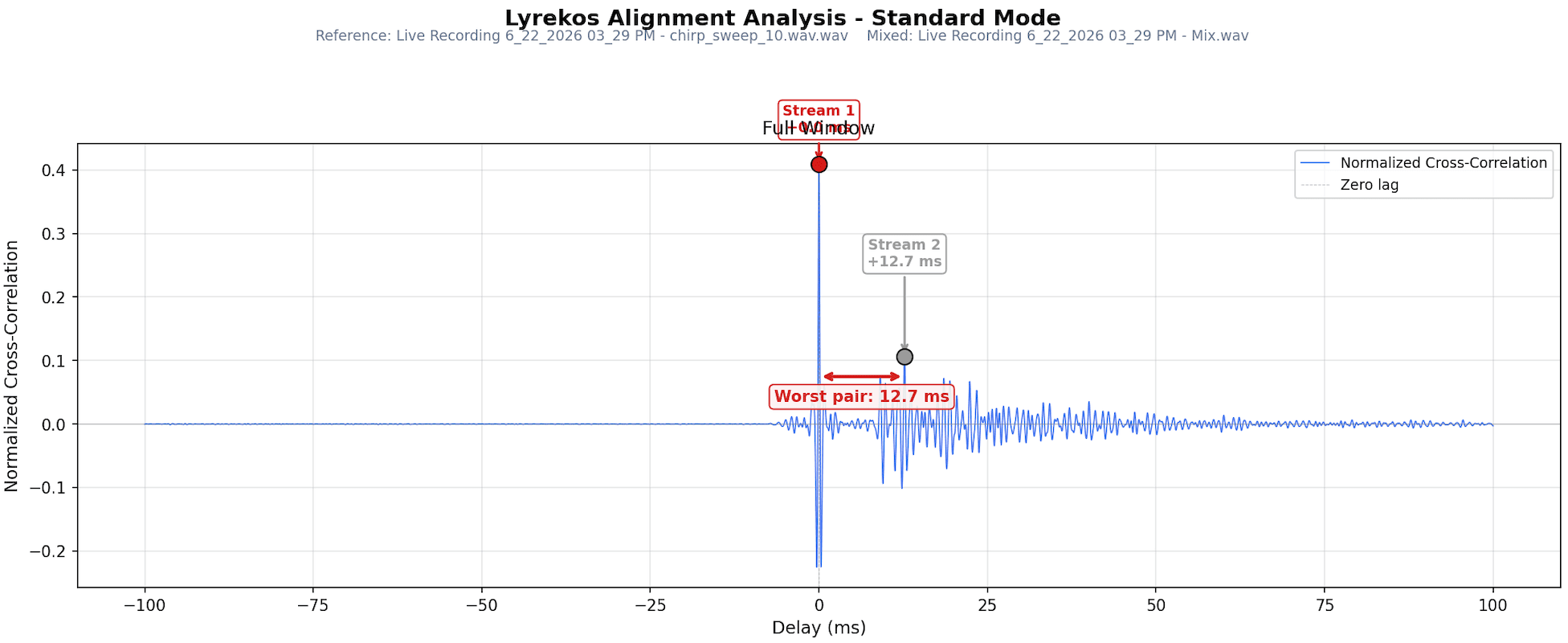
So why didn’t the satellite hop wreck us?
Because Lyrekos never tried to win the latency race in the first place. This is the jujitsu we keep talking about. Every other platform treats network delay as the enemy and burns enormous effort minimizing it — which is why they demand wired ethernet, professional audio interfaces, and singers who live in the same region. Fight the speed of light hard enough and you can get three people in the same metro area to jam. Add a satellite, and you lose.
Lyrekos sidesteps the fight entirely. Every singer performs against the same backing track, which acts as a shared temporal reference. Nobody is waiting on anybody else’s audio to arrive in real time, so it doesn’t matter whether your packets took 5 milliseconds or 500 to get where they were going. The synchronization comes from the reference, not from the network. Distance stops being a variable. (If you want the full explanation of why ordinary video calls can’t do this, we walked through it in Why Zoom Fails for Music.)
Which is a strange and wonderful thing to be able to say: our singers can be in different states, different countries, or on opposite sides of the planet, and the result is the same.
Or, apparently, on Starlink. Which means if you’re at a research station in Antarctica, on a boat in the middle of the Pacific, or — let’s just say it — eventually somewhere off the planet entirely, the architecture doesn’t care.
Now, we’re not going to make any claims today about singing with the crew of a lunar mission. The Moon is 1.3 light-seconds away, and that’s a longer conversation — one we may have sooner than you’d think.
But everywhere humans actually live and connect today? Lyrekos works there. The internet doesn’t have to be fast. It just has to be there.
Want to try it from wherever you are — satellite optional? Give it a try and sing together, wherever your voices are.

Lance Glasser
Lance is CEO and Co-founder of Kinetic Audio Innovations. He was previously a faculty member at MIT, Director of the Electronics Technology Office at DARPA, and CTO at KLA. He also makes sculpture, which has nothing to do with audio but explains the hundreds of pounds of bronze in his house.
Sing in Sync, Anywhere
If it works over Starlink, it works on your home Wi-Fi. Join the Lyrekos community and sing together across any distance.
Join our CommunityTry it