
There is something almost primal about voices joining in unison — not to sing, but to speak. Long before microphones, amplifiers, or streaming platforms, communities gathered to recite poetry, scripture, and story together, their words woven into a single collective voice. That practice has a name: choral speaking. And far from being a relic of the ancient world, it remains one of the most powerful pedagogical tools in music and language education today.
At Lyrekos, we think a lot about what it means to perform together across distance. Choral speaking turns out to be a surprisingly illuminating lens through which to understand that challenge — and the opportunity we're building toward.
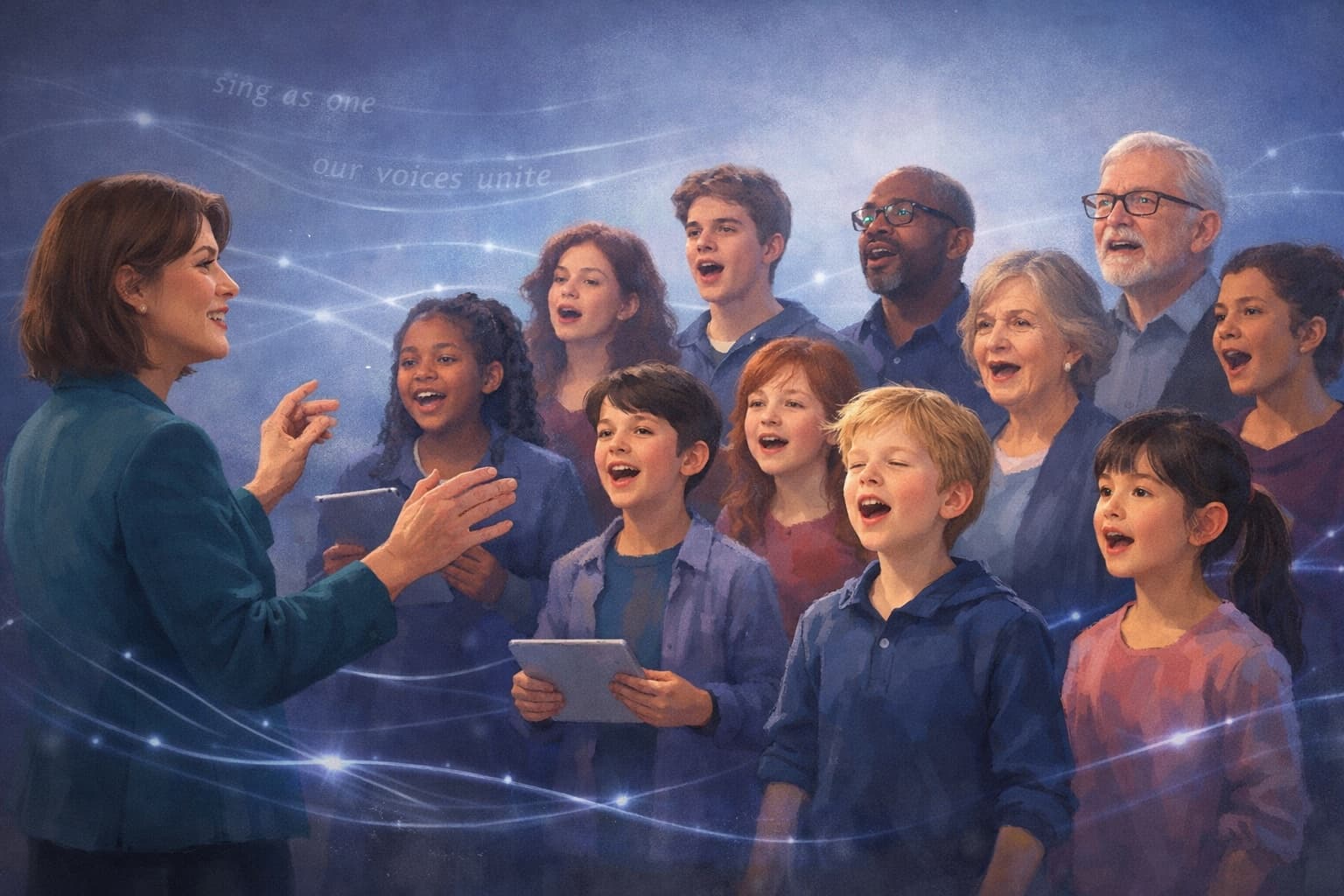
What Is Choral Speaking?
Choral speaking — also called unison speaking, verse choir, choral reading, or ensemble recitation — is the practice of a group speaking text aloud simultaneously, with shared rhythm, tempo, inflection, and dynamics. Unlike singing, there is no fixed pitch; the musicality comes from the collective coordination of pace, emphasis, and breath.
The roots go back thousands of years. Ancient Greek theater employed choruses not as ornamental backdrop but as dramatic necessity — the chorus gave voice to the community's conscience, commenting on the action in coordinated, rhythmic speech. In oral cultures across every continent, group recitation served similar purposes: preserving history, codifying law, reinforcing communal identity.
In the modern era, choral speaking found its way into the classroom through two distinct channels: the dramatic arts (verse choirs, poetry ensembles, competitive speech teams) and language education (particularly as a tool for pronunciation, fluency, and the treatment of speech disorders).
How Choral Speaking Is Used
The forms choral speaking takes are remarkably diverse.
Verse choirs and poetry ensembles are the most theatrical expression. Groups of students or performers divide a poem or text into sections — some spoken in full unison, others divided between high and low voices, solo voices emerging from and returning to the group. A well-conducted verse choir can render a Shakespeare sonnet or a Langston Hughes poem with the emotional range of a symphony.
Call and response is a simpler but enormously effective variation, in which a leader speaks a phrase and the group echoes, reinforces, or answers it. This structure is universal — you find it in African American church traditions, West African drumming culture, military cadence, and school classrooms alike.
Round-robin and antiphonal speaking divide a group into two or more parts that alternate or overlap, creating a dialogue effect from a single text. Think of how a congregation recites a psalm responsively, or how a debate team might rehearse synchronized rebuttal.
Classroom read-alouds in unison are perhaps the most ubiquitous form: a teacher leading students in reading a passage together, everyone's voice finding the same rhythm, no single speaker exposed or singled out.
The Educational Power of Speaking Together
English as a Second Language (ESL)
For language learners, choral speaking is not merely a warm-up exercise — it is a cornerstone methodology backed by decades of research. The benefits cluster around a few core mechanisms.
When learners speak in unison, the acoustic environment changes. Hearing one's own voice blended into a larger sound reduces the monitoring anxiety that causes non-native speakers to freeze, self-correct compulsively, or simply stay silent. The individual is temporarily released from the burden of solo performance. In that release, something opens: learners attempt sounds they would otherwise avoid, produce longer utterances, and internalize rhythm and stress patterns through muscle memory rather than analytical study.
Choral repetition is particularly effective for suprasegmental features — the melody, rhythm, and stress patterns of a language that textbooks struggle to convey. English, notoriously, is a stress-timed language; native speakers compress unstressed syllables in ways that confound learners trained in syllable-timed languages like Spanish, French, or Japanese. Repeating phrases chorally, with a skilled model, imprints these patterns at a level that silent reading simply cannot.
Research in communicative language teaching consistently identifies choral drilling as effective when used judiciously — not as rote memorization divorced from meaning, but as a bridge to confident individual production. The class speaks together until the group is ready; then individuals speak, now emboldened by what they have practiced in the safety of the ensemble.
Stuttering and Other Fluency Disorders
Perhaps the most striking application of choral speaking is in the treatment of stuttering. For reasons that are not fully understood — and that researchers continue to explore — most people who stutter speak with dramatic fluency when speaking in unison with others. The effect is immediate, robust, and remarkably consistent across individuals and severity levels.
Several theories have been proposed. Choral speech may alter the auditory feedback that stutterers process in an atypical way, reducing the neural "mismatch" thought to contribute to disfluency. The shared rhythm may provide an external pacing signal that compensates for disrupted internal timing mechanisms. Or the social dynamics of group speech may simply reduce the communicative pressure that triggers stuttering in the first place.
Whatever the mechanism, the clinical implications are real. Speech-language pathologists have long used choral reading as both an assessment tool (to demonstrate that fluency is achievable) and a therapeutic scaffold (to gradually shape fluent speech toward independence). Some stuttering treatment programs incorporate choral speaking as a daily practice, slowly fading group support while the speaker builds confidence and internalized rhythm.
Public Speaking Anxiety
The connection to public speaking anxiety more broadly is intuitive but worth naming explicitly. Glossophobia — the fear of speaking in front of others — is routinely cited as one of the most common human phobias, affecting an estimated 25 to 40 percent of the population to some meaningful degree.
Choral speaking addresses this not through desensitization alone, but through a more elegant mechanism: it gradually redistributes the social exposure of speaking. When you are one of thirty voices, the audience's gaze is not fixed on you. Your mistakes are absorbed by the group. Your successes are amplified by it. Over time, repeated experiences of speaking aloud without catastrophe begin to recalibrate the nervous system's threat response. Individuals who would freeze at a podium find themselves speaking freely in ensemble — and slowly, that freedom transfers.
Educators who use choral speaking as a classroom practice often report that students who rarely volunteer to speak begin to emerge. The ensemble becomes a rehearsal space for individual courage, a place where the voice discovers what it can do before the full weight of exposure arrives.
Choral Speaking and Lyrekos: Teaching at a Distance
Here is where the ancient practice meets a very modern problem.
All of the pedagogical benefits described above depend on one thing that technology has historically made almost impossible: synchronized group voice. You cannot do choral speaking over a standard video call. The latency — the delay between when you speak and when others hear you, and vice versa — produces not unison but chaos. Participants fall out of step. The blend collapses. The safety of the ensemble disappears, and with it, the very conditions that make choral speaking work.
This is the problem Lyrekos was built to solve. As we describe in our post on teaching music online, our platform uses a fundamentally different approach to remote audio synchronization. Rather than attempting to transmit voice in real time — fighting the physics of network latency — we use professional backing tracks as a synchronization reference. Each participant performs with the same reference track, and our system automatically aligns all performances with sub-20ms precision, regardless of where participants are located or what internet connection they're using.
The result is genuine ensemble performance across distance. And for choral speaking, that matters enormously.
A language teacher can now lead an ESL class in choral pronunciation drills — students in different cities, different countries, different time zones — with everyone in true unison. The acoustic safety of the group is restored. The rhythm and stress patterns land correctly. The individual is held by the ensemble, not abandoned to the latency gap.
A speech-language pathologist working with a client who stutters can conduct choral reading sessions remotely, without the client needing to travel, without the therapeutic effect being undermined by choppy audio or desynchronized speech.
A choir director building ensemble cohesion — whether the ensemble is singing or speaking — can work with singers across campus, across the country, across the world, and hear and capture how the voices blend.
A student terrified of public speaking can rehearse in the relative safety of a remote ensemble, gradually building the embodied confidence that eventually makes solo speaking feel possible.
Lyrekos does not replace the teacher, the therapist, or the director. What it does is restore the conditions under which these practitioners can do their best work — conditions that until now required everyone to be in the same room.
Conclusion: The Ensemble as a Teaching Technology
Choral speaking has endured for thousands of years not because it is convenient, but because it works. It works for language learners who need a safe space to inhabit a new tongue. It works for people whose speech disorder lifts, mysteriously and reliably, in the presence of other voices. It works for the anxious speaker who discovers, gradually, that their voice is capable of more than fear has allowed.
The ensemble is itself a teaching technology — one of the oldest and most effective we have. At Lyrekos, our goal is to make sure that technology is available to every teacher, every student, every practitioner, regardless of where they happen to be.
Because the voices belong together. And now, they can be.
Lance Glasser
Lance is CEO and Co-founder of Kinetic Audio Innovations. He was previously a faculty member at MIT, Director of the Electronics Technology Office at DARPA, and CTO at KLA. He also makes sculpture, which has nothing to do with audio but explains the hundreds of pounds of bronze in his house.
Bring Choral Speaking to Your Remote Classroom
Join our community to get early access for educators and speech-language pathologists.
Join our CommunityTry it